Sky Chart For The Month of February, 2026
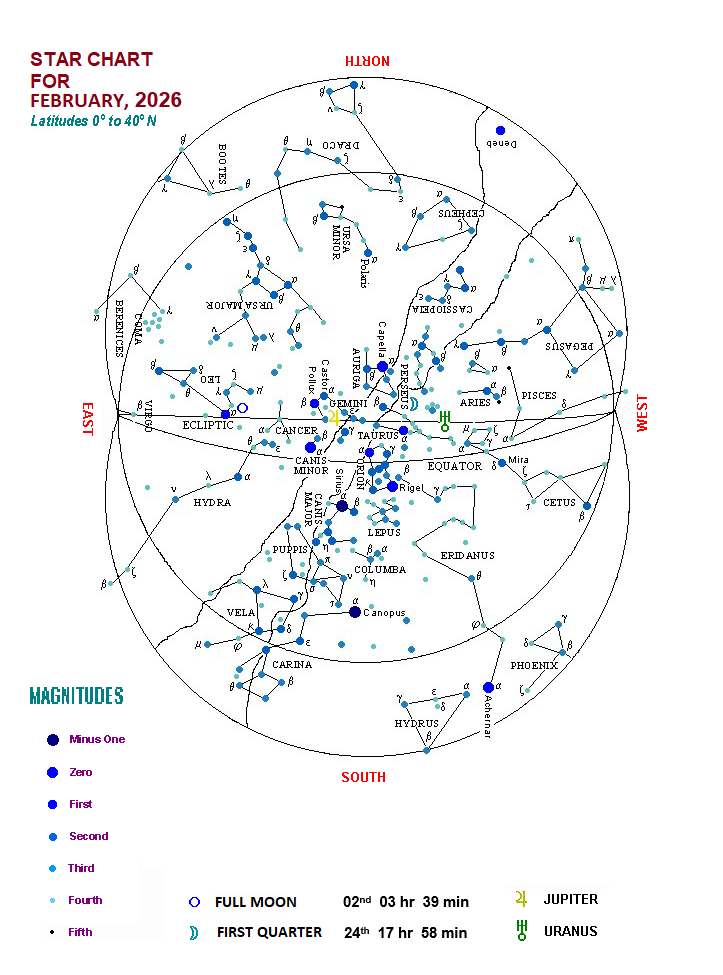
ASTRONOMICAL BULLETIN FOR FEBRUARY 2026
The Moon
|
Full Moon occurs on 02nd at h. 03-39 I.S.T. |
Last Quarter occurs on 09th at h 18-13 I.S.T. |
|
New Moon occurs on 17th at h 17-31 I.S.T. |
First Quarter occurs on 24th at h 17-58 I.S.T. |
|
The Lunar Crescent becomes first visible after the New Moon day in the evening of 18th. |
|
|
The Moon is at Apogee or farthest from the Earth on 10th and at Perigee or nearest to the Earth on 25th. |
|
The Moon passes about 1º south of Mars on 16th, about 1½º north of Venus on 18th, about ½º south of Mercury on 19th, about 3½º north of Neptune on 20th, about 4½º north of Saturn on 20th, about 5½º north of Uranus on 24th, about 3º north of Jupiter on 27th.
Eclipse
Solar Eclipse:
Annular solar eclipse will occur on 17th February. The eclipse begins at 15-27 I.S.T. and ends at 19-58 I.S.T. The eclipse will not be visible in India.
The Planets
Visibility of Planets:
Mercury: The planet is too close to the Sun to be visible upto 4th. From 5th it becomes visible in the western sky after sunset. It sets about ½ to 1 hour after sunset initially, increasing gradually. It is in Greatest Eastern Elongation (~18º) on 19th. It reaches Perihelion on 19th. Motion becomes Retrograde from 26th.
Venus: Not visible upto 1st. From 2nd, visible in western sky after sunset. Sets ½ to 1 hour after sunset throughout the month.
Mars: Too close to the Sun to be visible.
Jupiter: Sets 1½–2 hours before sunrise early, increasing to 2½–3 hours before sunrise.
Saturn: Sets 3½–3 hours after sunset early, reducing gradually to 1½–2 hours after sunset.
Uranus: Sets around midnight initially, then earlier. Motion becomes Direct from 4th. In Quadrature on 16th.
Neptune: Sets 3½–3 hours after sunset early, reducing gradually.
Conjunction of Planet:
Mercury passes about 4½º north of Venus on 27th.
| Planets | Planets in Zodiacal Constellation | Magnitude |
| Mercury (Budha) | Moves from Capricornus (Makara) to Aquarius (Kumbha) on 3rd. | -1.3 to +2.0 |
| Venus (Sukra) | Moves from Capricornus (Makara) to Aquarius (Kumbha) on 6th. | -3.9 |
| Mars (Mangala) | Moves from Capricornus (Makara) to Aquarius (Kumbha) on 23rd. | +1.2 |
| Jupiter (Brihaspati) | Remains in Gemini (Mithuna). | -2.6 to -2.4 |
| Saturn (Sani) | Remains in Pisces (Mina). | +1.1 to +1.0 |
| Uranus | Remains in Taurus (Vrisha). | +6.0 |
| Neptune | Remains in Pisces (Mina). | +8.0 |
Source: Director
Positional Astronomy Centre
India Meteorological Department
Salt Lake, Kolkata - 700 091.